The Quiet Authority

A Biography of Deghiat Hassen Ali

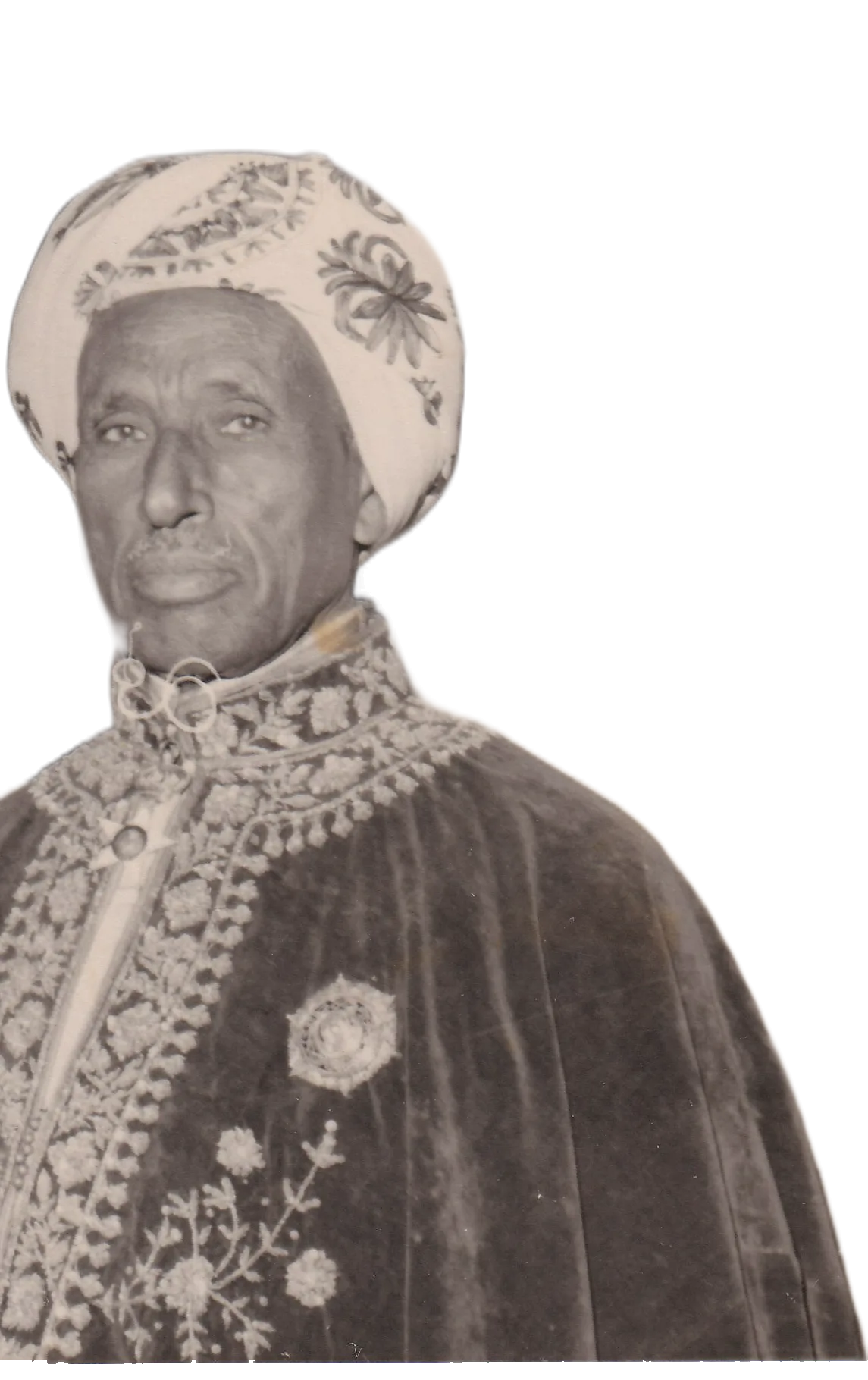
Deghiat Hassen Ali in a patterned turban and an embroidered velvet cloak with a decoration on the chest

Yussuf Hassen Ali and Mustafa Lyesdie

A digital museum

Deghiat Hassen Ali

1883–1964

“When power changed hands, his authority endured.”

The Quiet Authority, back cover

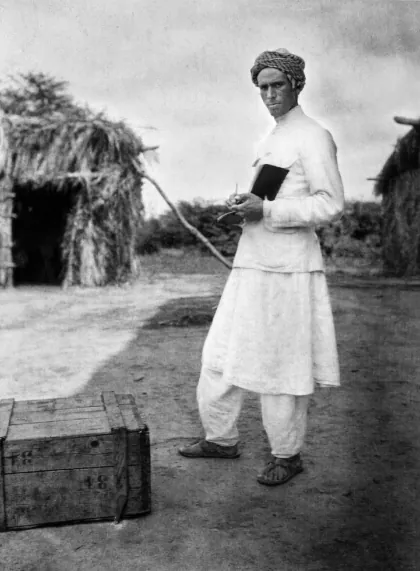
Hassen Ali as a young man in white, writing in a notebook beside a wooden chest
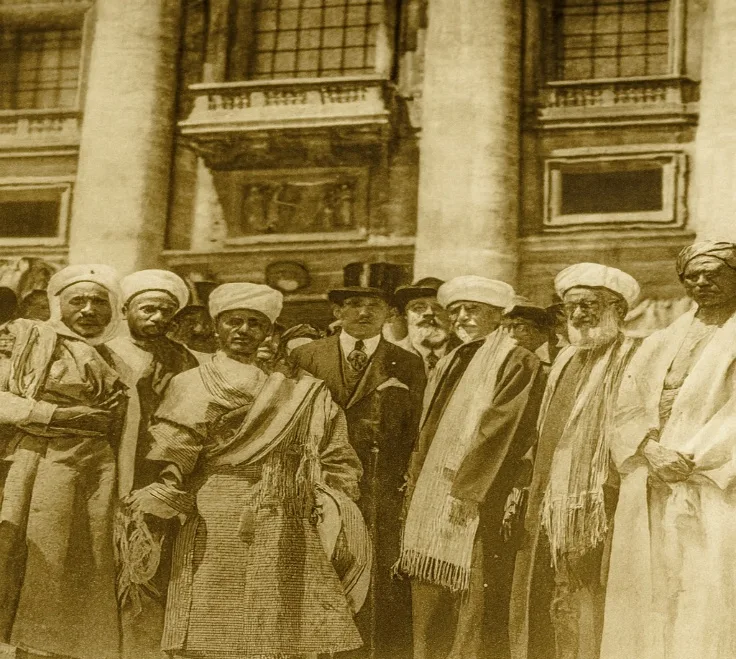
A delegation in turbans and robes standing in front of a great stone building
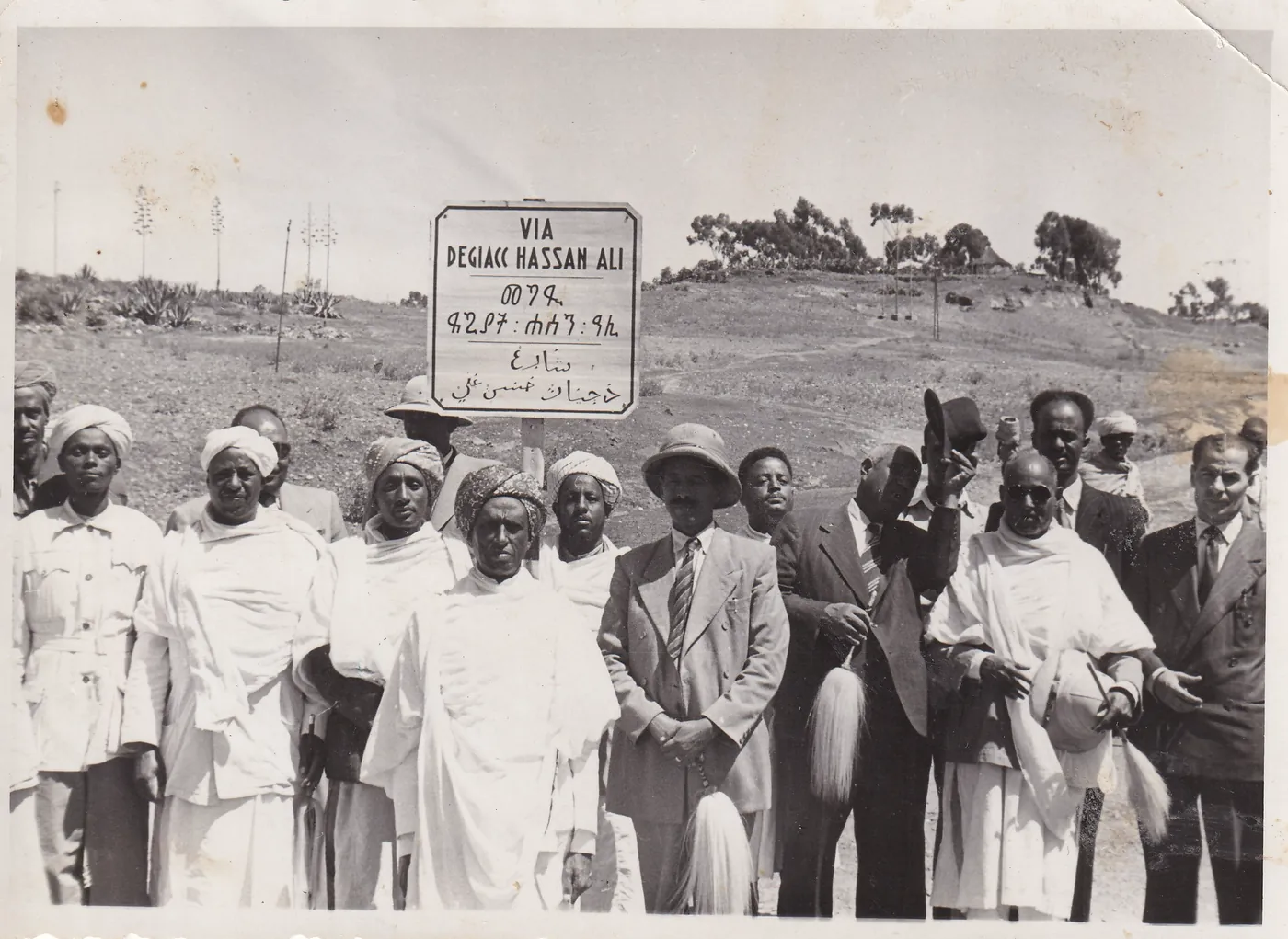
A crowd gathered under a street sign that reads Via Degiacc Hassan Ali
Illustration of the setting, AI-generated

1883

The world he was born into

Hassen Ali was born on 13 March 1883 in the village of Addi Hanniso, in the Seraye province of the Eritrean highlands. Massawa was then under Egyptian control, and Italy already held Assab.

Source: The Quiet Authority, pp. 7 and 20

The highlands at Senafe, in what is now Eritrea, about 1867–1868. Photograph by Ronald Ruthven Leslie-Melville. J. Paul Getty Museum, 86.XA.21.85.

The way in is an illustration: the land is drawn from elevation data, and its last seconds show this room’s AI-generated setting.

Illustration of the setting, AI-generated

1897–1938

Across empires and sea

Around 1897, at about fifteen, he entered the Italian colonial civil service in Asmara. As an interpreter he was sent to the Somaliland frontier, to the consulate in Hodeida in Yemen, and to Jeddah.

Source: The Quiet Authority, pp. 9, 49, 74 and 77

Hassen Ali, aged 27, in 1910, at a mission on the Ethiopian-Somali border – the earliest known photograph. The Quiet Authority, p. 70.

Illustration of the setting, AI-generated

1926 or 1927

With the Yemeni prince in Rome

He travelled to Italy with the delegation of Sayf al-Islam Muhammad, the son of Imam Yahya of Yemen, on the prince’s state visit to Rome. The book’s narrative dates the visit to 1926; the biographical dictionary of 1952 that it cites says June 1927.

Source: The Quiet Authority, pp. 83 and 166

1926 in Peter’s Basilica, Vatican, Rome. Far right: Hassen Ali stands at the edge of the Yemeni Mission in Rome – Prince Saif al-Islam Mohammed and the Yemeni notables, accompanied by the Italian colonial Governor of Eritrea, Jacopo Gasparini. The Quiet Authority, p. 83.

Illustration of the setting, AI-generated

1938

A Grand Mufti for Eritrea

Rome was considering a cleric from Tripoli, rather than a local scholar, as Grand Mufti of Eritrea. Hassen Ali took it upon himself to secure the candidate: he wrote two urgent letters to Sheikh Ibrahim al-Mukhtar in Cairo.

Source: The Quiet Authority, pp. 112–113

Deghiat Hassen Ali (left), Mufti Sheikh Ibrahim Al-Mukhtar (3rd from left), Eritrean Muslim leaders and British Administration officers. The Quiet Authority, p. 115.

Illustration of the setting, AI-generated

1939

Between the state and the people

In 1939 he was appointed Quarter Chief of Asmara’s Second Quarter; the book calls it the only municipal head position in Asmara held by an Eritrean. He governed, it says, “the space between empire and community”.

Source: The Quiet Authority, pp. 5, 11 and 99

Left to right: Qadi Musa Adem Omran and Deghiat Hassen Ali, and British Military officers. The Quiet Authority, p. 119.

Illustration of the setting, AI-generated

1947

The case for independence

In February 1947 he wrote that the struggle for independence was a common national interest shared with Christian brothers. On 16 December he appeared before the Four Power Commission with Abdelkadir Kebire and Ibrahim Sultan.

Source: The Quiet Authority, pp. 140 and 144

Deghiat Hassen as a leader at the forefront of the demonstration of the Eritrean Muslim League for the independence of Eritrea, Asmara 1947. The Quiet Authority, p. 210.

Illustration of the setting, AI-generated

1949

A street in his name

On 28 May 1949 Asmara named a city street after him. “He was never known to strive for rank, promotion, or personal gain,” the Grand Mufti wrote.

Source: The Quiet Authority, pp. 118 and 147–149

During the Ceremony for the Naming of an Asmara City Street – Via Degiacc Hassan Ali (May 28, 1949). The Quiet Authority, p. 149.

Illustration of the setting, AI-generated

Three flags

Sixty-seven years of service

“He remained in the service of the government for sixty-seven years, serving under three different flags—the Italian, the British, and the Ethiopian,” the Grand Mufti of Eritrea wrote of him in 1964.

  • Italy, until 1941
  • Britain, 1941–1952
  • Ethiopia, from 1952

Source: The Quiet Authority, pp. 110, 118 and 151

Hassen Ali, possibly photographed during his official mission to Italy in 1938. The Quiet Authority, p. 109.

Illustration of the setting, AI-generated

What he left

Hassen Ali died on 29 February 1964 in his home in Asmara, surrounded by family. Today his descendants number in the hundreds, perhaps even more.

Source: The Quiet Authority, pp. 5 and 161

Deghiat Hassen Ali. The Quiet Authority, p. 161.

Available on Amazon

The Quiet Authority

A Biography of Deghiat Hassen Ali

by Yussuf Hassen Ali and Mustafa Lyesdie

Buy on Amazon
Illustration of the setting, AI-generated

About this museum

Every statement about Deghiat Hassen Ali on this page is taken from the biography The Quiet Authority; the page of the book is given at each checkpoint. The photographs are those reproduced in the book, except the photograph in the first room, which comes from the archive listed at the end. The photographs are shown here toned and mounted for this site; apart from that the image files of the book’s photographs are the book’s, with only the white margins of its typesetting cut away. The portrait on the cover of the book shown here is the family photograph P034, from the family’s collection.

The way from the book into the first room is a film made for this site: an illustration, not a record. Its land is drawn from elevation data (NOAA ETOPO 2022 and Copernicus DEM GLO-30) and its coasts, lakes, rivers and ground cover from Natural Earth. Which land it colours as Egypt’s, Abyssinia’s and Zanzibar’s is read from the Carte générale de l’Afrique by E. Andriveau-Goujon, Paris 1884 (Bibliothèque nationale de France, btv1b53179697w); the colours, the names and the year are set by us. Its last seconds show the AI-generated setting of that room. Copernicus DEM: © DLR e.V. 2010–2014 and © Airbus Defence and Space GmbH 2014–2018, provided under COPERNICUS by the European Union and ESA; all rights reserved.

The settings of the rooms that the visitor walks through, each as one still image and in three layers of depth, the materials of the book and its desk, and the icon of this site in the browser tab are AI-generated illustrations. They show no real person and are not historical images:

  • A rock massif with a sheer tower, standing on a bare stony plain at dawn, drawn as a sepia engraving
  • A dhow under sail on the open sea at dawn, with nobody on deck, drawn as a sepia engraving
  • The square and the dome of St Peter’s in Rome, empty, drawn as a sepia engraving
  • A hall of pointed arches with carved stucco, lattice windows and hanging brass lamps, empty, drawn as a sepia engraving
  • An office with a heavy carved desk, ledgers, an oil lamp and tall shuttered windows, empty, drawn as a sepia engraving
  • An assembly hall with rows of wooden benches and tall doors open onto a sunlit street, empty, drawn as a sepia engraving
  • An arcade along an empty city street lined with palms, with a hanging lantern, drawn as a sepia engraving
  • A long stone gallery with three tall empty niches, drawn as a sepia engraving
  • A quiet inner room with a carved door, woven baskets and a coffee tray, empty, drawn as a sepia engraving
  • The parchment-coloured ground of the book’s cover, with its ornaments
  • The paper of the book’s pages
  • The dark wood of the desk the book lies on

From archives:

  • The highlands at Senafe, in what is now Eritrea, about 1867–1868. Photograph by Ronald Ruthven Leslie-Melville. J. Paul Getty Museum, 86.XA.21.85. Public domain.
Buy the book